Finding 01
The admin is real, and nobody bills for it
Producers lose four to eight hours a week to paperwork that never reaches an invoice. It is the most expensive part of the job and the least visible one.
Killshot is an agentic vertical software company out of Stanford's Product Design department, rebuilding the workflows that independent insurance agencies still run by hand. I sized the market, wrote the customer profile, designed the system and built it, owning the product end to end.
The console
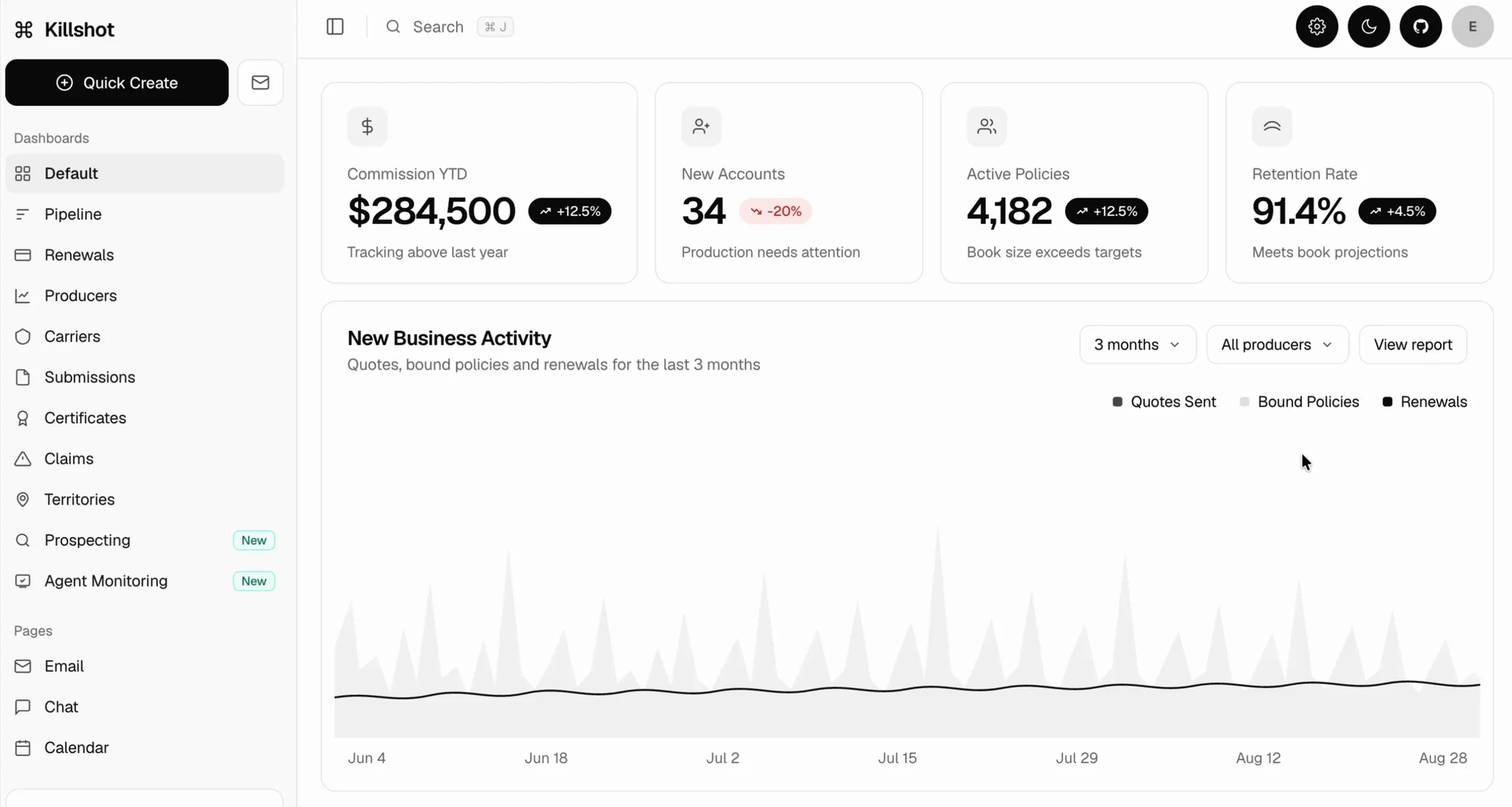
Commission, retention, the policy count and the prospect list on the front page, and every automated action landing on a record the owner already reads.


User research
I interviewed 24 people across independent property and casualty agencies, from owners to the producers and CSRs who actually run the paperwork. I went in expecting a workflow problem and came out with a liability one, which is the finding the entire product is built on.
Finding 01
Producers lose four to eight hours a week to paperwork that never reaches an invoice. It is the most expensive part of the job and the least visible one.
Finding 02
A tool that drafts the forms is a weekend build. What stops it going live is who carries it when it is wrong, and every conversation arrived at that question.
Finding 03
An agency of five to fifteen buys on the owner's judgement, with no committee and no procurement cycle. That set the price, the wedge and the sales motion in one move.
These are why the product sells refusal rather than coverage. An agent that publishes what it will not touch answers the objection the interviews kept producing, and no competitor was designing for it.
Problem
Imagine...
A twelve-person agency in one state writes $2M of commercial property and casualty. Producers lose four to eight hours a week to admin nobody bills for. The prototype that automates it works in a weekend. Then the first wrong form goes out under the agency's name, and the fix becomes an errors and omissions claim.
Carrier Email Triage
Routes carrier and client correspondence arriving in the shared mailbox
3,204 runs · 92.8% success
What it closes without a human:
Every tool in this market sells coverage: more workflows, more of the job, more of the day. Killshot was the bet that refusal, not coverage, was the moat.
Solution
Most agency AI makes oversight a monthly report nobody opens. I built three refusal primitives into every agent instead: a published success rate, a confidence floor, and a named person the work falls to when the floor is missed.

I sorted every workflow by what a wrong answer costs, not by how often it happens. Unhelpful, embarrassing, or a claim. Only the first two are allowed to run unattended.

ACORD pre-fill sits at 71.3%, under the 85% floor, so it runs in review and says so on the front page. After hours intake is paused. Holding two of seven agents back is the feature, not the backlog.
When an agent misses its floor the work does not queue silently. It routes to the producer or CSR who owns that book, and the handoff is counted on the dashboard as escalations, which is the number an owner should actually watch.
Agencies do not run on agents. They run on renewals, submissions, and a book that has to reconcile, so I put the agents inside that data model rather than beside it. Every automated action lands on a record the owner already reads.

A network of agents, triage, intake, certificates, loss runs, and renewals, splits the work one CSR would otherwise chase across five systems and three days, and closes most of it before the producer opens the inbox.
1 The agent names what it will not resolve

2 And publishes why it handed those back

An escalation is a row in the same table as the work, not a separate log. The message keeps its carrier, its account, and its reason for stopping, so a person picks it up with the context already attached.

But wait... there is more
Most agency AI stops at the inbox. The book layer, renewals, pipeline, carriers, and producers, is where Killshot stops being a bot and earns the word console.
A renewal list sorted by date tells an owner nothing. I ranked the book by rate change, carrier posture, and account size, so the accounts that decide the quarter sit at the top of the first screen.

When a carrier moves a class outside appetite and eleven policies remarket at once, the renewal view shows which accounts moved, what the rate change is, and who owns each one, so an owner can triage the book instead of the calendar.
Producers forecast on feel and the number is always high. Every opportunity carries its stage probability, so $1.42M of weighted pipeline against a $412K quarterly bind goal reads as a position rather than a hope.

The two questions an owner asks are where a risk can go and who is actually writing. I built them as two views on one data model, so the answer to either one is three clicks from the other.

Appetite, quote rate, and turnaround decide where a submission goes. Bind ratio and validation progress decide who gets the next lead, and who is still 17 months from covering their own book.

The demo
The whole console in one pass: the book, the agents, what they hand back, and who picks it up.
Reflection
Co-founding this meant every decision was load bearing in both directions, as the designer choosing what an agent may do on its own, and as the founder who has to sell that answer to an owner who has never opened ChatGPT.
What it taught me:
Sizing down is a design decision. Cutting 39,000 agencies to 10,900 set the price, the sales motion, and the feature list in one move, because an agency of five to fifteen people buys on one person's judgement and no committee.
The constraint picks the product. Applied gates production credentials behind approval and Vertafore ties scopes to what each agency licensed, so I led with the work that never touches the management system rather than waiting on a partner gate that may never open.
Sizing is a product decision, not a slide. The market sizing is verified against outside industry economics rather than a vendor's headline number, and it is what set the price, the wedge and the roadmap. Getting that number honestly is what makes every decision downstream of it defensible.